
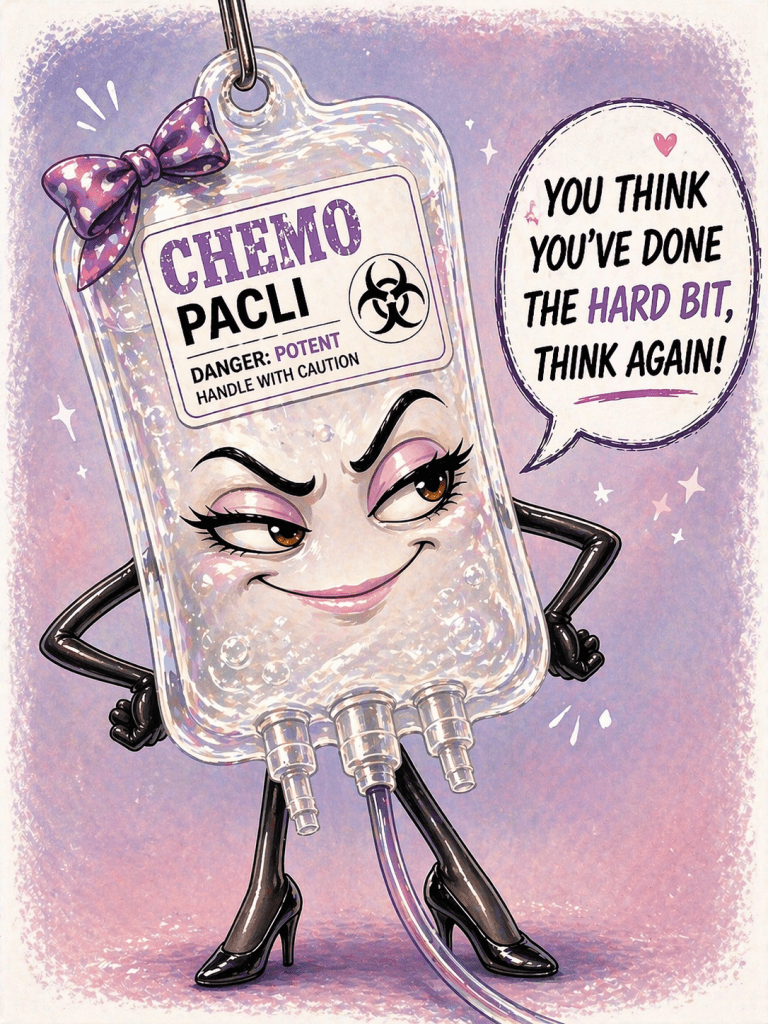
When I finished Epirubicin, everyone seemed very happy about it. Lots of “well done” and “you got through the hard part.”
This is usually the exact moment when I start getting suspicious that something’s not quite right. Not that the world is out to trick me, and I never really warmed up to a paranoia diagnosis, but still… this is always that moment in movies when the unexpected twist hits. Everyone is celebrating, completely unaware, and you’re just standing there thinking: this feels off… just like the calm before the storm.
And as we all know—movies are based on reality.
Pre-medication
At this point, I definitely wasn’t expecting any drama—apart from the cold cap, which, as I’ve mentioned many times, is already hardcore drama on its own. But as you might have guessed… things didn’t exactly go as expected.
They warned me mainly about paclitaxel’s tendency to cause allergic reactions, possible nail damage, and the risk of neuropathy—so naturally, I hyper-focused on those. Patient information leaflets? Ignored at this stage. Self-defense against unnecessary panic.
So off I went, confidently, like a seasoned chemo veteran…
…and then the pre-medication knocked me out so hard I barely knew who I was.
If you’ve ever experienced that moment where you’re just about to fall asleep—but instead of drifting off, you suddenly feel like you’re falling… then you wake up gasping, hoping you’ll never feel that again…
Yeah. It was exactly like that.
Except there was no waking up.
I stayed in this half-coma, falling again and again, almost without pause.
At the same time, I was somehow aware of my surroundings. For example, I noticed that all the nurses suddenly ran off in the opposite direction and disappeared. (Later I found out there was some emergency.) Brilliant.
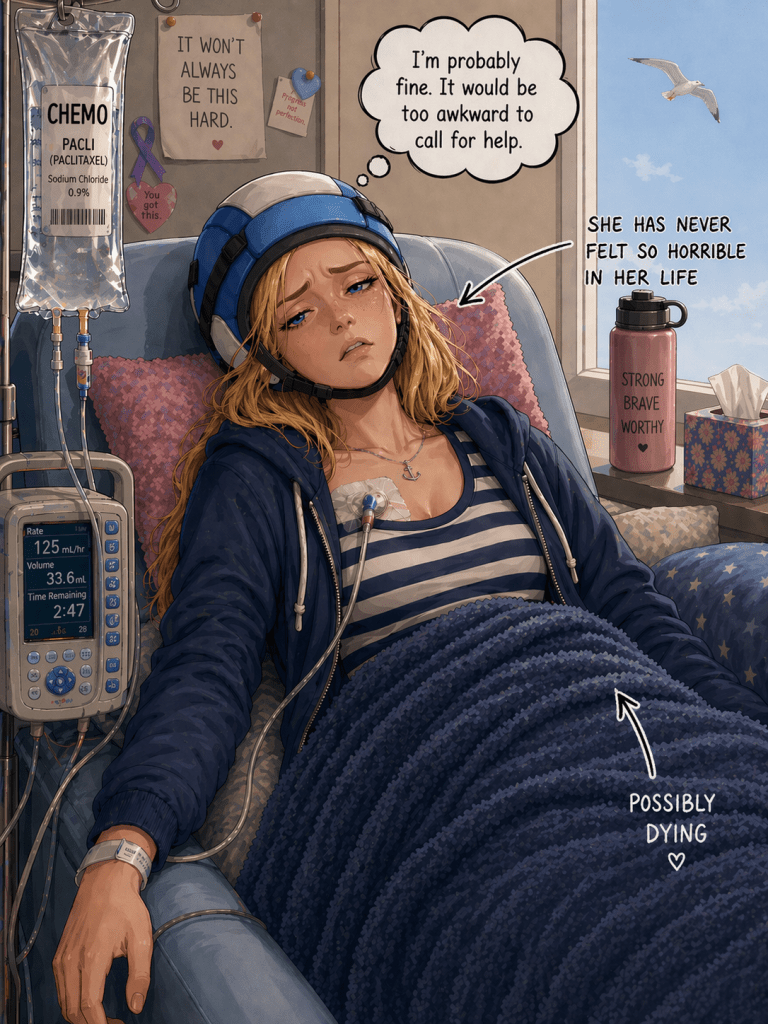
So there I was, half-conscious, thinking—what if I have an allergic reaction?
(The paclitaxel had already been started somewhere at the beginning of this “trip.”)
On one hand, I might not even notice it because of the constant falling. On the other, even if I did notice, I wouldn’t be able to say anything.
The call button wasn’t in my hand (so much for being a chemo veteran). Maybe it was nearby. Maybe someone was nearby. I don’t know. I was there—and not there.
Meanwhile, allergy or not, the falling itself made me feel like I was on the edge of checking out.
That exact moment I’ve only ever felt before on a plane in heavy turbulence—when you think: this is it.
Only there, you can kind of surrender to it—“nothing I can do now.”
Here, the constant falling kept me on edge, and somewhere in the background there was still the option of trying to call for help with my last bit of strength. But when?
Is this already an emergency?
Or how would I even know if, beyond the horrible sensations, something truly serious was happening?
From time to time, someone passed through my field of vision. Sometimes I felt too weak to call out. Other times I hesitated because—what if it’s not actually an emergency and I embarrass myself?
Funny, isn’t it… how we’d rather suffer—or even die—than risk feeling awkward.
And this went on until suddenly…
my head felt clearer.
The falling stopped.
Yes.
How much time had passed? No idea.
Did I make it?
I made it.
There was no question whether I should say something when someone finally came over. The real question was whether I’d ever want to set foot in that place again.
What the hell was this even? Definitely a level of hell I’m not masochistic enough for.
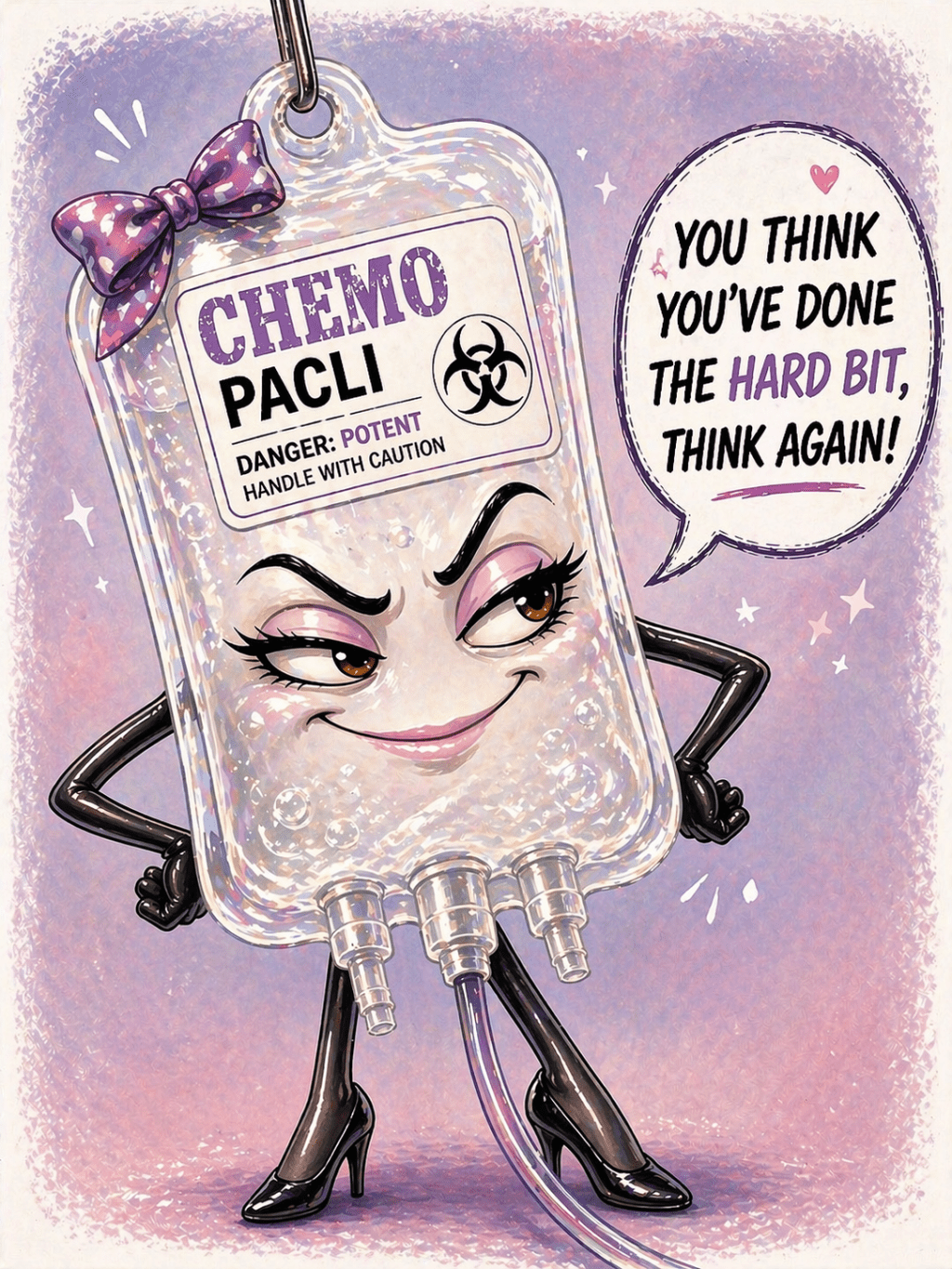
So much for “you’ve already done the hard part.”
When a nurse came over to disconnect the now-empty infusions and leave me alone with the queen of all suffering—the cold cap—I told her about my “journey.” She immediately knew it was caused by the antihistamine component of the pre-medication.
She must have seen that I was already planning my escape, because she instantly offered to speak to the doctor and suggest switching to an oral version, which is somewhat milder. She did that—but unfortunately, before the change happened, I had to go through that nightmare once more.
At least this time, the nurses didn’t disappear—and I made sure I could actually signal if things got bad enough to outweigh embarrassment.
The Aftermath of Paclitaxel
Since EC and paclitaxel follow each other, the side effects blur together at first.
The mouth sores continued during the first two weeks of paclitaxel, so I couldn’t tell which drug was responsible—but since they eventually went away, I suspect EC still had a role in it.
Hair loss also continued, despite my hopes. This became increasingly frustrating because people kept asking, “Isn’t it slowing down by now?”
No. It wasn’t.
It started slowly and evenly—and continued exactly like that.
The question kept coming because slowing down is the usual pattern, which made my situation feel especially unfair.
But what felt even more unfair?
Body hair started coming back—along with random early regrowth on my head.
Bye-bye Leeloo.
Hello completely uneven, oddly shaped hair situation.
My eyebrows and eyelashes, however, only partially fell out—and started growing back almost immediately. And the cold cap doesn’t even affect those. I hadn’t really heard others mention this. Just goes to show—everyone is different.
The intense early flu-like symptoms from EC didn’t continue. Instead, there was a steadily increasing fatigue. Probably not helped by the fact that paclitaxel was given weekly.
I felt like my body never had time to recover before being hit again.
The 10,000 steps I had faithfully maintained started to drop. I began cancelling plans more often. Part of that was probably just the cumulative effect of treatment.
The weekly cold cap sessions also started to push me over the edge.
And then slowly… something crept in. Let’s call it neuropathy.
It started with intense itching in my hands, then my feet—like millions of ants crawling over them—then progressed to an agonising prickling sensation.
Cold made it worse, and so did anything that touched them more than usual. I immediately stopped wearing bracelets (no idea where I threw them), gloves too, and even walking—something that had helped maintain my fitness—became a nightmare.
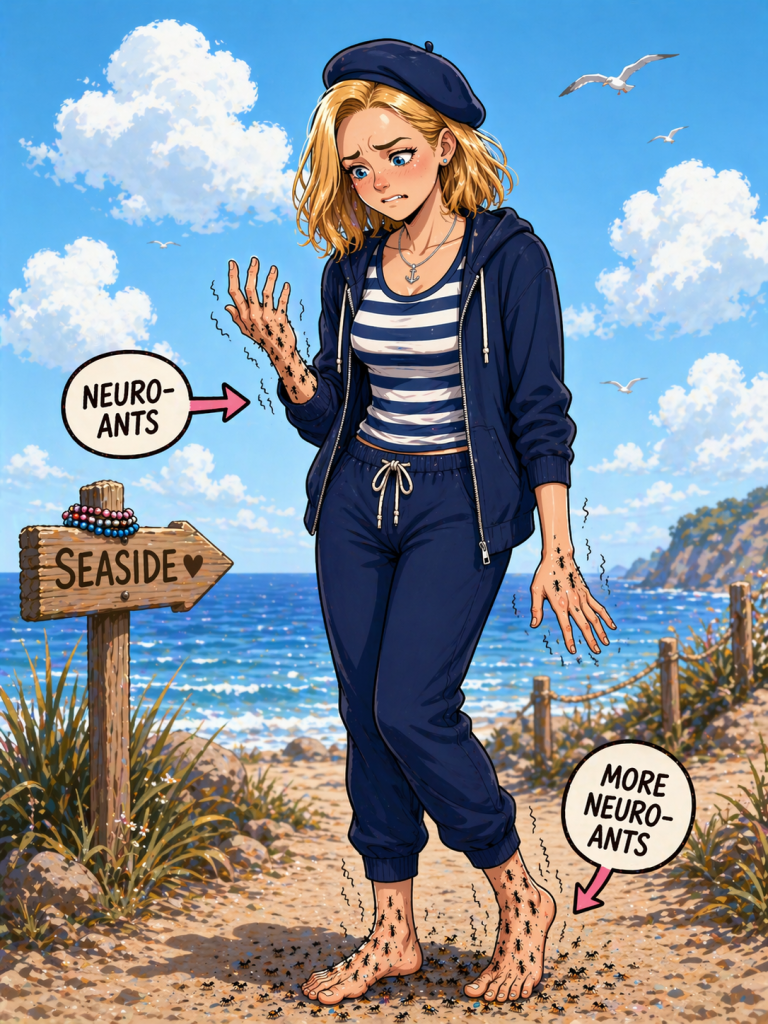
Two fingertips also became numb, and still are, but it didn’t spread further.
The reason I wasn’t sure whether it was neuropathy is because it didn’t fully match the typical picture. (It did not spread for instance) Some people said “definitely yes,” others weren’t convinced. I think the final conclusion was “atypical neuropathy.”
By then, I was already extremely frustrated.
Neuropathy has this lovely feature of potentially becoming long-term. And while there was still uncertainty, all I knew was that the symptoms were unbearable—and not something I wanted to live with long term.
At the same time, I was afraid to stop treatment, because that might reduce my chances of long-term survival.
With all the other sneaky symptoms piling on, it eventually led to a moment where, during a walk, the ‘ants’ overwhelmed me so badly that I felt unwell and had to be picked up—and I ended up skipping my next treatment.
By then, I’d had enough of paclitaxel.
And I decided: confirmed—movies are based on reality.
After the missed session, I did two more treatments, and then chemo buddy and I went our separate ways.
The Decision to Stop
This wasn’t a decision I made lightly.
It was one of those impossible choices where, no matter what you do, you might regret it.
At some point, we agreed that I had neuropathy—and as it kept getting more intense, the idea of living with it long-term felt like a nightmare.
Also, in my specific case, the benefit of the last three treatments was questionable anyway.
So—leap of faith: goodbye paclitaxel.
Later, it turned out only minimal cancer remained after chemo.
Would it have disappeared completely if I had finished? Who knows.
But the ants, thankfully, moved on.
I just hope that wasn’t temporary relief.
The Extras (Because Why Not)
Something I didn’t mention yet: chemotherapy can also cause temporary—or permanent—menopause. That happened somewhere halfway through, but honestly, it barely stood out among everything else.
Why not? Join the queue.
And then there’s our lovely friend: chemo brain.
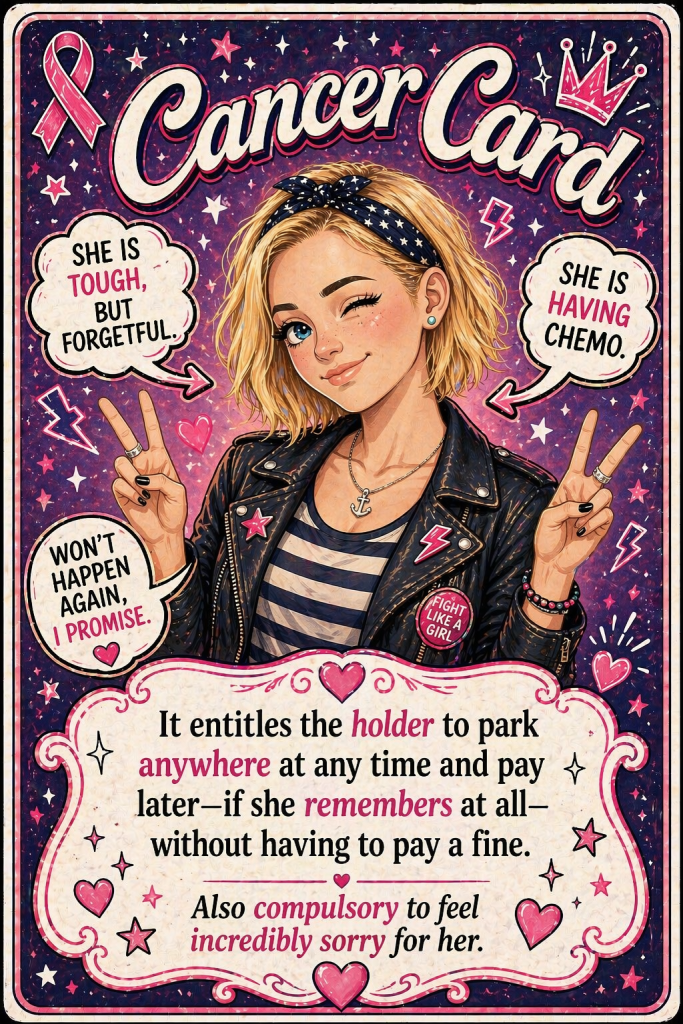
Thanks to that, I became quite familiar with local parking authorities while repeatedly trying to metaphorically present my non-existent “cancer card.”
Also—don’t be surprised if you see me hopelessly wandering around a carpark looking for my car.
This can stick around long term too.
But hey—at least now I have something to blame it on.
Nice to meet you, chemo buddy.
I sincerely hope we never meet again though—no offense.
Adios. 🌻

 Blooming Anyway
Leave a comment