If you ask cancer survivors what the worst part of their story was, many will say the moment of diagnosis.
For me, it was much more the eight weeks that followed — a stretch I wouldn’t relive even in my worst nightmares.
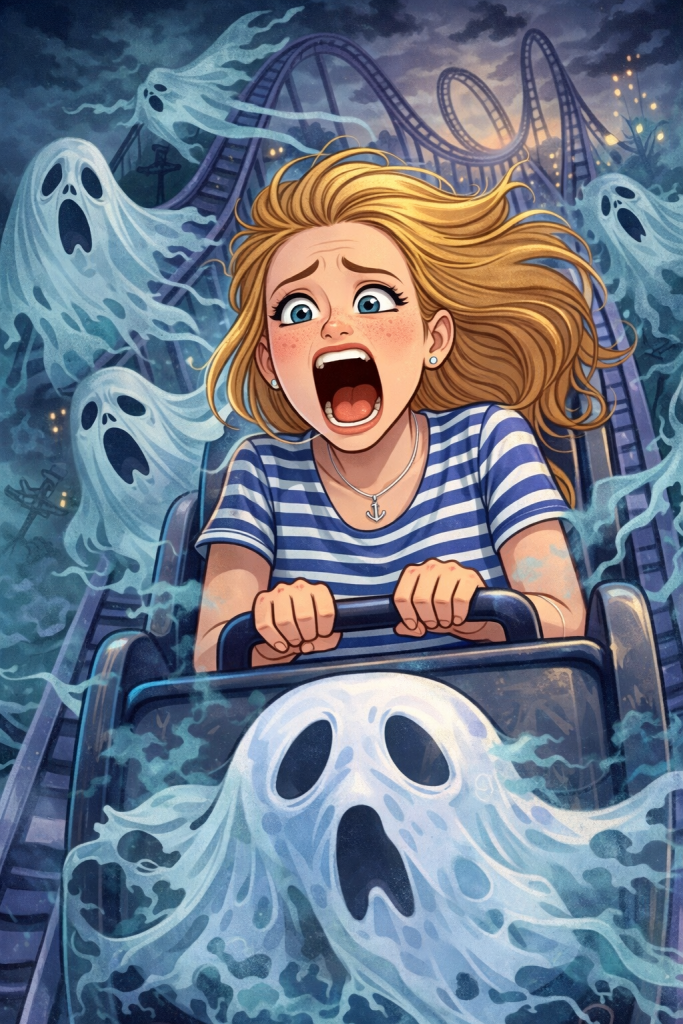
If we compare cancer to a roller coaster — and so far I haven’t found a better metaphor — then this phase felt like some hybrid between a haunted house and a roller coaster. (Does such a thing even exist?)
To begin with, there are people you have to tell relatively quickly — sometimes the very next day — like your workplace, close family members, friends.
You stand there with fresh trauma in your hands, hoping you can get through the sentence without breaking down or losing your thread. And within minutes you find yourself comforting others, listening to advice about planning your death (which even the doctors haven’t dared to mention yet), or watching someone abruptly close the conversation — and you already know you probably won’t see them much in the coming months.
Cancer ghosting is one of the most brutal and unexpected punches in the cancer bootcamp. It deserves its own essay, but for now it’s enough to say: not everyone is strong enough to stay. Natural selection. As painful as it is at first, it simplifies things later.
But when you share the news, the real heroes of cancer also reveal themselves — people who don’t have to stay, yet they do. Or they step forward. Sometimes it’s just a hug. A “whatever happens, I’m here.” A random text message. It can mean the world. And often it comes from People — with a capital P — you wouldn’t have expected. From then on, they get a front-row seat in your heart. God bless them.
As more and more people hear the dreadful news, another question emerges: how public do you go? Which potential bad outcome is more tolerable — being openly defined as “the girl with cancer,” or having people whisper behind your back? My pessimistic self says, “If more than one person knows, everyone knows” — especially on a small island — so I didn’t chase illusions. I chose the first option, resigned.
People’s reactions also force you to confront that your identity is not only going to change — you’re already in the middle of that change, in medias res, as we were taught in high school.
Until now, my narrative was about someone bursting with health (despite the very Hungarian habit of constant complaining), running around, working, saying yes to everything, burning the candle at both ends, chasing harmless pleasures for fun, and planning at least as far as great-grandchildren.
Now that self-image and that certainty shatter into pieces. A lump just a few centimeters wide rewrites everything in a single moment. It’s incredibly hard to process rationally and emotionally that physically you don’t feel any different than yesterday — yet from now on you are fighting for your life, potentially poisoning what still works with toxins, because a piece of paper says: “cancer.”
And you have no idea who this new, now potentially mortal version of you is.
You desperately try to cling to your old self — the one you built over forty-something years — but everyone wants to talk about the illness. As fewer other things happen to you, you don’t really have anything else new to say. Fate forces you to choose who you’ll be in this new role: heroic warrior, victim, or some tightrope-walking combination rooted in reality.
While you struggle with telling people, trying to process that life has slapped you in the face with your own mortality, endlessly typing into search engines about your chances of having a tomorrow, another layer begins: the uncertainty and waiting that now feels eternal. You need to understand the enemy before you can attack.
Cancer isn’t one disease; it’s many different ones. Treatment depends on type and stage — and so do the chances of recovery. But nothing is ever certain, and the road is anything but linear.
Emotionally, this meant constantly waiting to see whether the next test result would deliver an immediate death sentence or a brutal treatment plan that at least offered a chance at a future. And it wasn’t a single round. It was the ongoing program of the first eight weeks.
Waiting for the appointment letter.
Showing up for the test (sometimes looking like a patchwork quilt or a pincushion if you get an inexperienced nurse).
Waiting for results.
Getting a call before the scheduled results appointment: “It’s not ready yet, let’s reschedule.”
Sitting in front of the doctor, terrified this is where the final drama unfolds —
then walking out simultaneously relieved (“not yet”) and disappointed because “not all results are in, and the ones we have need repeating.”
Three ultrasounds. Two biopsies. One full-body MRI and one chest MRI. CT scan. Two mammograms. On the edge of a nervous breakdown, I was also advised to get a PET-CT — which would have required flying to England. That proved to be too much. In time. In nerve cells. In everything.
My refusal didn’t make me particularly popular. But at least I finally received my well-deserved (or not) aggressive treatment plan — and the death sentence was postponed for an uncertain period.
Deep breath.
The small joys of life.


 Blooming Anyway
Leave a comment